Press kit
Figures you can quote with the source and the verification date behind each one, the dates this decision runs on, and our diagrams as files under CC BY 4.0.
Who we are
lunartime.org is a reference site on lunar timekeeping, written and checked by Lunartime Editorial — an editorial signature, not a person — and described in full on about lunartime.org.
Facts you can quote
Each line below is written to be quoted as it stands: it carries the number, both scales the number compares, and the word model where the value is a modelled one. Under each is the document it comes from, the date that document was published, and the date we last opened it and confirmed it still says this.
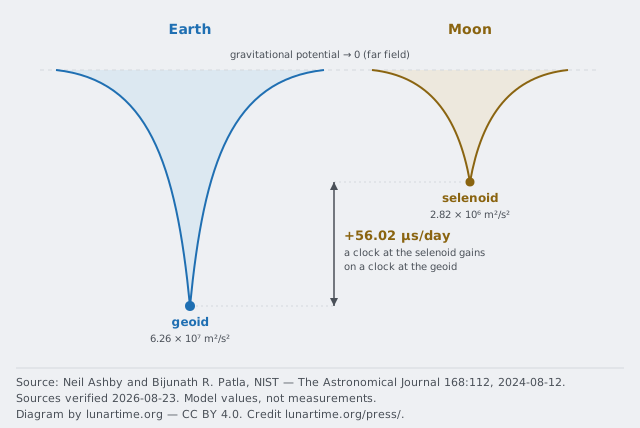
A clock at rest on the Moon's selenoid gains 56.02 µs per day on a clock at rest on Earth's geoid. The figure is a model value computed from the published rate, not a reading taken on the Moon. [1]
Source: A Relativistic Framework to Estimate Clock Rates on the Moon — Neil Ashby and Bijunath R. Patla, NIST — The Astronomical Journal 168:112, 2024-08-12. Verified 2026-08-23. On this site: how we calculate lunar time.
Lunar Coordinate Time (TCL) runs 58.7 µs per day faster than Terrestrial Time (TT). This is the rounded figure quoted in the United States policy memorandum of 2 April 2024, and it compares a different pair of scales than the surface figure above. [2]Official
Source: Policy on Celestial Time Standardization — White House Office of Science and Technology Policy, 2024-04-02. Verified 2026-08-23. On this site: 56 vs 58 microseconds.
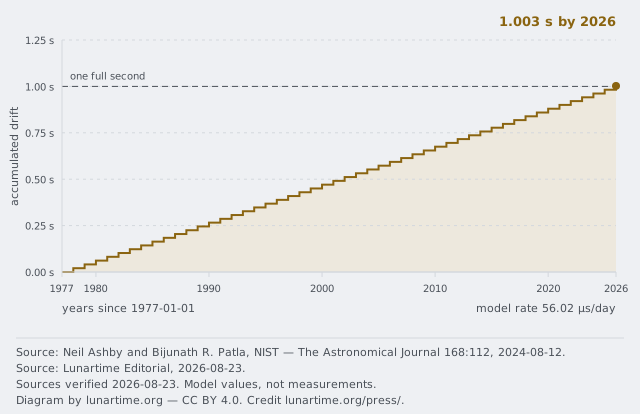
Over 18 159 days, from 1977-01-01 to 2026-09-20, the model puts a clock at rest on the Moon's selenoid ahead of a clock at rest on Earth's geoid by 1 017 267.18 µs (1.017267 s). [3]
Source: Our calculation: the lunartime.org clock model — Lunartime Editorial, 2026-08-23. Verified 2026-08-23. On this site: the drift calculator.
At 56.02 µs per day, the model puts a full second between a selenoid clock and a geoid clock about every 48.9 years. [3]
Source: Our calculation: the lunartime.org clock model — Lunartime Editorial, 2026-08-23. Verified 2026-08-23. On this site: the lunar clock.
One microsecond of clock error between a lunar clock and an Earth clock is 299.79 m of light path, which is why microseconds on the Moon are a navigation problem rather than a scheduling one. [3]
Source: Our calculation: the lunartime.org clock model — Lunartime Editorial, 2026-08-23. Verified 2026-08-23. On this site: why microseconds matter.
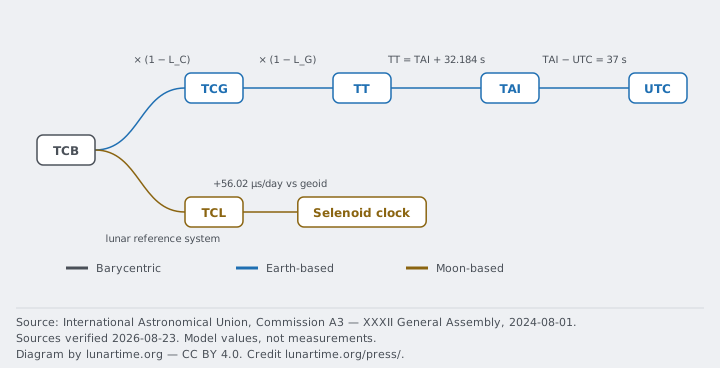
Lunar Coordinate Time has a fixed epoch: TCL reads 1977 January 1, 0h 0m 32.184s exactly when Barycentric Coordinate Time (TCB) reads the same at the centre of the Moon. [4]Official
Source: Resolution to establish a standard Lunar Celestial Reference System (LCRS) and Lunar Coordinate Time (TCL) — International Astronomical Union, Commission A3 — XXXII General Assembly, 2024-08-01. Verified 2026-08-23. On this site: TCL in the glossary.
Lunar time reaches the 28th CGPM as Draft Resolution D — one of six drafts, three of which concern time — proposing an international lunar reference time scale traceable to UTC. No vote has been taken. [5]Official
Source: Convocation of the 28th meeting of the CGPM (O/Ref AK-CFA-2026-1001) — Bureau International des Poids et Mesures / CIPM, 2026-01-13. Verified 2026-08-23. On this site: Draft Resolution D in full.
Two figures, not one, and they are not interchangeable: 56.02 µs per day compares a clock on the lunar surface with a clock on the Earth geoid, while 58.7 µs per day compares two coordinate scales, TCL and TT. A microsecond figure printed without the pair of scales it belongs to is the single most common error in reporting on this subject.
Key dates
Three dates carry the story. Two are ahead of us and one has passed; none of them tells you what will be decided, and neither do we.
| Date | What the document says is scheduled | Source |
|---|---|---|
| 13–15 October 2026 | The 28th General Conference on Weights and Measures meets at the Palais des Congrès de Versailles. Lunar time is Draft Resolution D, item 17 on the provisional agenda circulated on 13 January 2026. | [6]Official |
| 31 December 2026 | The date the United States memorandum sets for NASA to deliver a finalized strategy implementing lunar timing standardization to the Executive Office of the President. | [2]Official |
| 31 December 2024 | The earlier deadline in the same memorandum: a milestone-based approach to establishing LTC, and consideration of LTC in the Moon-to-Mars Architecture Concept Review. Our registry holds no document reporting what was delivered, so we do not say. | [2]Official |
The wording of the 2026 deadline, verbatim from the memorandum:
NASA will, in coordination with the Departments of Commerce, Defense, State, and Transportation, provide a finalized strategy to the Executive Office of the President to implement lunar timing standardization no later than December 31, 2026.
Diagrams
Three SVG files, published under CC BY 4.0. Each one is the same drawing this site uses, exported as a standalone file: colours are baked in, so it opens correctly outside our stylesheet, and the source and the licence are written inside the file itself, where they cannot be separated from the picture.
Gravity wells of the Earth and the Moon[1]
Why a lunar clock runs faster: two potential wells side by side, with the rate difference between the selenoid and the geoid marked between them.
Family tree of the time scales[4]Official
Where TCL sits among TCB, TCG, TT, TAI and UTC, with the relation written on every edge.
Drift accumulated by a model lunar clock[1][3]
How the model drift adds up year by year from the 1977 epoch, and where it crosses one full second.
The credit line to put under a diagram:
Diagram: lunartime.org, CC BY 4.0. https://lunartime.org/press/How to credit us
- Diagrams: CC BY 4.0. Use them anywhere, including commercially, as long as you credit lunartime.org, link to this page, and say so if you changed the file.
- Facts: link to the page you took it from. Every fact above names the page on this site where it is worked out, and the document it rests on. Link to the document if you link to only one thing — the primary source deserves the weight more than we do.
- Text is ours. Page text is © Lunartime Editorial. A sentence quoted with attribution is fine; republishing a page is not. Dates, rate figures and resolution numbers taken from the primary documents are fact, not our property: take them and cite the issuer.
- Keep the word model, and keep both scales. Every lunar clock value here is arithmetic on a published rate, and a rate without the pair of clocks it compares means nothing. Both conventions are in the sentences above; please carry them through.
What we are not
- We are not a standards body and hold no part in any of these decisions. We are not BIPM, NASA, the IAU, ESA or a national metrology institute, and nothing here has official status[7]Official.
- We do not predict decisions. No page on this site says how the 28th CGPM will vote or what will be adopted; where a decision has not been taken, we say that it has not been taken.
- No lunar time scale has been realized. Nothing on the Moon is being read into a time scale today, so every lunar value here is a model value [3].
- We do not supply a named human expert. Lunartime Editorial is an editorial signature, and we will not invent a person to put in your piece.
Contact
Write to press@lunartime.org. What you get back is a plain answer with the document behind it, or the sentence that we do not know — we would rather be uninteresting than wrong on a deadline. If you need a figure checked before you file, send the sentence you intend to print and we will tell you whether the sources support it.
Sources
- A Relativistic Framework to Estimate Clock Rates on the Moon
- Policy on Celestial Time Standardization
- Our calculation: the lunartime.org clock model
- Resolution to establish a standard Lunar Celestial Reference System (LCRS) and Lunar Coordinate Time (TCL)
- Convocation of the 28th meeting of the CGPM (O/Ref AK-CFA-2026-1001)
- 28th meeting of the CGPM (2026)
- Resolution on the establishment of a coordinated lunar time standard by international agreement
Last verified